
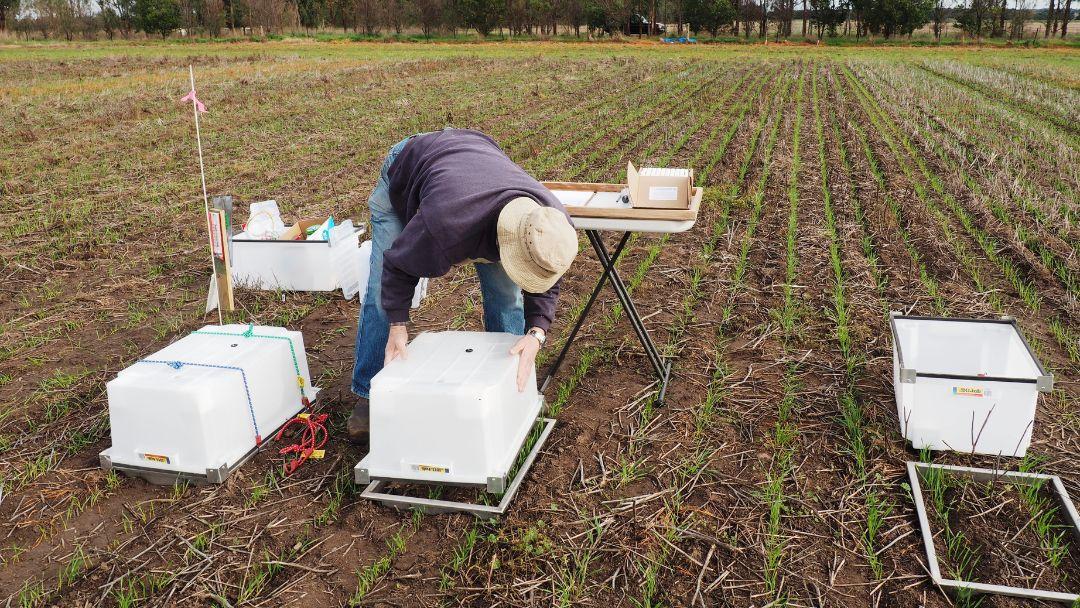
IMAGE: Collection chambers used for monitoring nitrous oxide emissions from soil
The previous article on this topic discussed the effect of wheel traffic on the ability of soil to infiltrate and store water for crop use. The final figure in the article illustrated the influence of soil type on the relationship between bulk density and ‘plant available water capacity’ (PAWC – water available between field capacity and wilting point). The data shown were for some common US soil types.
Equivalent PAWC – bulk density relationships for some common Australian soils are shown in Figure 1. With a couple of exceptions, the Australian soils have a higher clay content (45% – 75%) than the US soil used in our previous analysis (which ranged from 10% – 60% clay content).
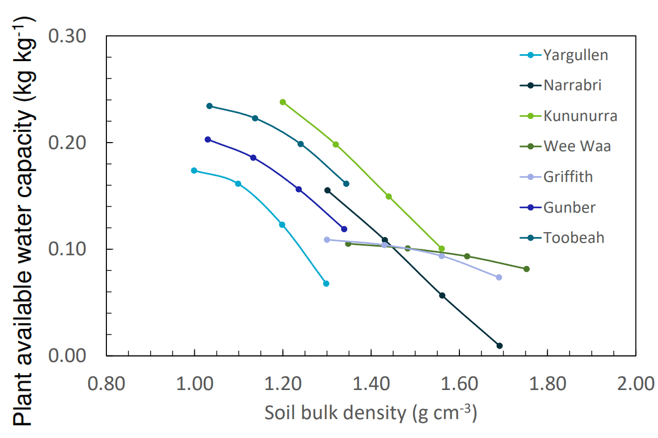
Figure 1: Effect of soil bulk density on plant available water capacity (PAWC) in a number of Australian clay soils (after Ngo-Cong et al. 2025).
The soils featured in Figure 1 are: Black Vertosol (Yargullen, Kununurra); Grey Vertosol (Narrabri, Toobeah); Transitional Red-Brown Earth (Griffith, Gunber); Red Chromosol (Wee Waa).
These relationships can be used to illustrate the impact of compaction on the ability of soil to store water for subsequent crop use.
To take a few examples from Figure 1:
- Kununurra Black Vertosol – 24% increase in bulk density (BD) results in 55% reduction in PAWC
- Yargullen Black Vertosol – 18% increase in bulk density (BD) results in 55% reduction in PAWC
- Narrabri Grey Vertosol – 30% increase in bulk density (BD) results in 95% reduction in PAWC
CTF and N loss
Water relations are obviously critical for productivity in many Australian environments, but field traffic has many other impacts on productivity and sustainability. First amongst these would probably be its impact on the loss of nitrogen fertiliser. N loss can occur in runoff and erosion, and also with waterlogging and denitrification. Both are related to infiltration rates, and both mechanisms almost certainly contributed to an instance of widespread loss of up to 75% of applied N reported after a prolonged post-planting rainfall in Central Queensland. Such major losses are fortunately rare, but smaller losses are common.
Direct measurement of N losses is difficult and expensive: it can be done using isotope-labelled N, but it’s easier to estimate by measuring nitrous oxide emissions from the denitrification process. It’s a process that can occur rapidly when water-filled pore space (WFPS) is over 80%. It also happens faster when the soil is warmer[1].
While WFPS of 80% can occur after any significant rainfall event, N loss will be related to the length of time the soil remains in a high WFPS condition. This will depend on infiltration rate, so greater N loss occurs when compaction slows infiltration. This effect was tested by measuring soil emissions of nitrous oxide at 15 field trials across 6 sites in WA (Esperance), Victoria (Inverleigh, Horsham, Swan Hill) and Queensland (Toowoomba) between 2013 and 2016.
In this work, soil emissions were assessed in commercial paddocks after sowing and fertilising replicated plots comprising non-wheeled CTF soil, their adjacent permanent traffic lanes and a single wheeling on that CTF soil. Emissions were sampled 12 – 18 times at each of the 15 field trials over the period between sowing/fertilising and harvesting, with most samples being taken in the 2 months after sowing.
The results of this work were clear: overall mean nitrous oxide emissions and N loss from the single random wheeling were 2.3 times higher than those from soil in the CTF bed, and N loss from permanent traffic lanes was 1.9 times higher than that from the CTF bed. Losses were highly variable, but always greater from wheeled treatments by factors ranging from 1.2 to 5.0. Mean losses were slightly greater at the southern region sites, clearly influenced by rainfall patterns in relation to fertiliser application.
On this basis, CTF systems might be expected to reduce nitrous oxide emissions and N loss by 30 – 50%, compared with typical non-CTF systems. This could represent between 6 and 15 kg/ha N, and be financially useful in some seasons. Nitrous oxide also has almost 300 times the global warming impact of carbon dioxide, so it’s normally cropping agriculture’s greatest contribution to climate change. This CTF reduction in nitrous oxide emissions would be the equivalent of 400 kg CO2/ha, which could also be valuable in terms of carbon credits payments – but these effects still need to be properly validated.
In summary, high bulk density (as a result of compaction) reduces both the volume and continuity of pores in the soil. As a result, smaller rainfall events can more quickly fill the pores with water (high WFPS). Reduced pore volume and continuity leads to slow internal drainage and slow infiltration of surface ponded water, so a high WFPS is maintained for longer. This extended time of high WFPS dramatically increases the risk of N loss through denitrification.
CTF and Soil Health
The precise meaning of “health” in relation to soil is rarely defined, but soil fauna are essential to many soil functions. Earthworms are almost invariably mentioned in any discussion of the topic and sometimes referred to as the soil’s “ecosystem engineers”. Increases in earthworm activity have often been noted by growers adopting CTF, and this was investigated at UQ Gatton over 2 years from 1999.
In this work tillage and traffic effects on soil fauna levels were assessed 13 times at two-month intervals from 4 replicates of 3 tillage traffic treatments in grain production, with each treatment replicate split into wheeled and controlled (zero) traffic sub-plots. Three sub-samples of 150 mm diameter x 150 mm depth were taken from each subplot, and sieved in the field so earthworms could be counted before transfer to the laboratory for mesofauna and microfauna population assessments.
Results of the work were clear and illustrated in Figure 2: overall mean earthworm populations in controlled traffic no-till, wheeled no-till and controlled traffic tilled soil were greater than those in wheeled tilled plots by factors of 6.7, 2.9 and 2.3 respectively. A small but generally similar mean response was found in mesofauna[2] (mites and springtails) populations. Effects on microfauna (bacteria, fungi and nematodes) were much smaller.
[1] An interesting article from the University of Wisconsin, estimating temperature effects on N loss can be found at https://www.canr.msu.edu/news/potential_for_nitrogen_loss_from_heavy_rainfalls . It also provides estimates of the time required for the nitrogen content of different fertilisers to be converted to the nitrate form which is prone to being lost.
[2] Effects independently confirmed in other places.
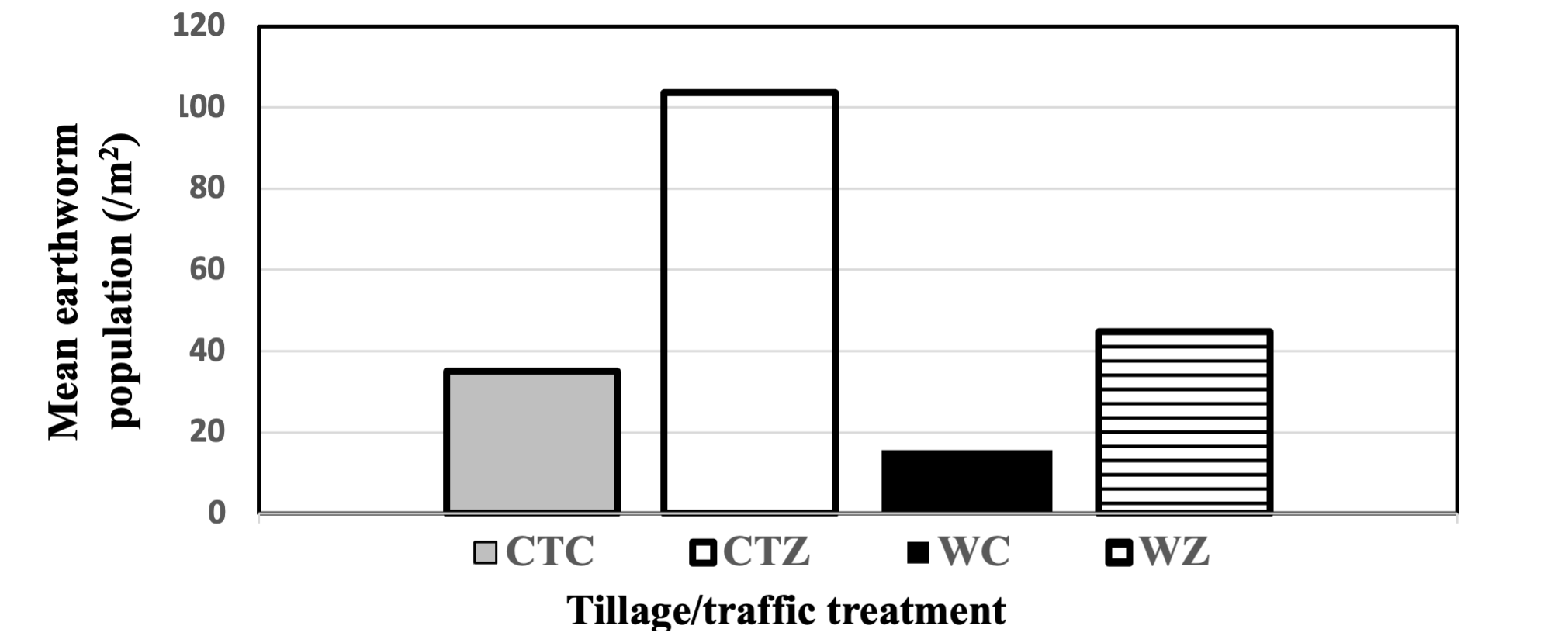
Figure 2. Tillage and traffic effects on overall mean earthworm populations. (CT = controlled traffic, W = wheeled, C = conventional tillage, Z = no-till)
These are commonsense effects: compaction and tillage are likely to have a direct physical impact on larger soil fauna, just as they first effect the larger soil pores. Direct effects on mesofauna are smaller, and microfauna probably avoid direct damage. Indirect effects like soil aeration would affect all soil fauna and might account another finding from this work – the reduced proportion of parasitic (v. beneficial) nematodes2 in the non-compacted soil of CTF beds.
None of this will come as a surprise to growers who have observed the beneficial effects of CTF which are valuable in terms of both their economic and their environmental impact. They are also effects that show up very quickly in shrink/swell soils of Queensland and northern New South Wales. It would be valuable to repeat the infiltration, N loss and soil fauna investigations on the more rigid soils of the southern and western regions.