
Bindi Isbister, Agrarian Management
Georeferenced or GPS mapped paddock boundaries are central to modern farm automation. They define the “digital farm” – they guide machines, organise data, drive analysis, underpin calculations of inputs, costs and profit, and link multiple datasets together. In theory, these boundaries should make everything seamless.
In reality, they’re one of the biggest complications in precision agriculture.
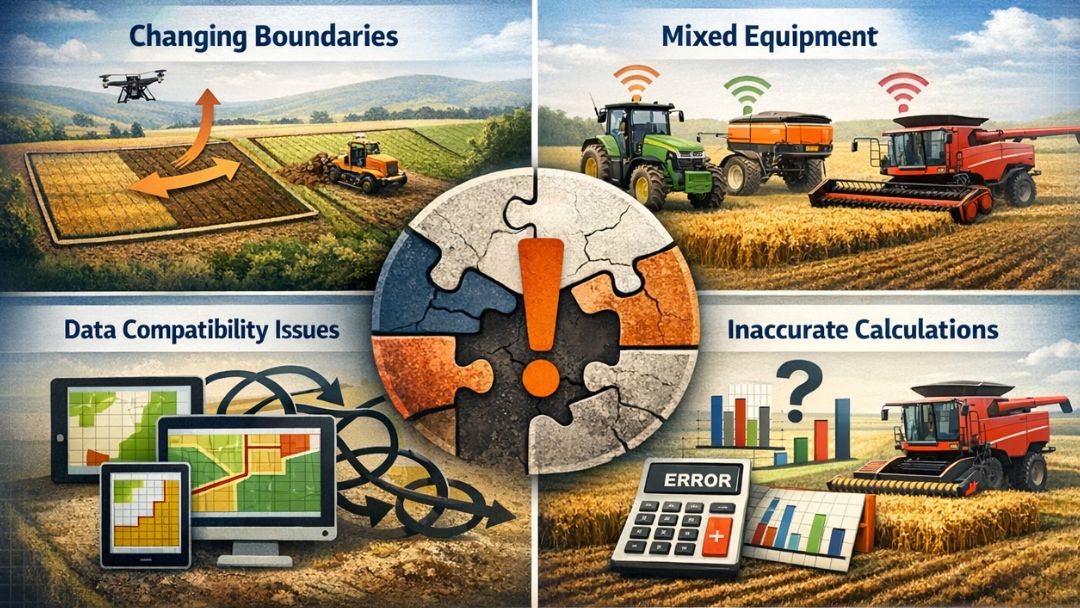
1. Boundaries are not static – but software treats them as if they are
Despite how we think of them, paddock boundaries are constantly changing:
-
- paddocks are merged or split for efficiency.
- obstacles are removed or added.
- drains or roads are installed.
- headlands are reshaped.
- corners are re mapped for machinery to navigate better.
These real world changes make it very difficult to maintain consistent digital boundaries across software systems. Editing boundaries is usually the easy part – the nightmare is moving 10+ years of historical data attached to those old boundaries.
Merging paddocks is simple. Splitting them again? – very time consuming.
2. Different machinery brands map boundaries differently
As equipment gets more accurate, slight differences become major problems. Today’s machines operate at sub meter – often sub 10 centimeter – precision. So when:
- two systems disagree by 0.5 – 1 m
- or boundaries captured 3 – 5 years ago no longer align
…it creates issues in guidance, application, mapping and analytics.
To make matters worse, different manufacturers use different correction formats:
- John Deere uses NCT, a proprietary RTK correction format.
- most of the industry uses RTCM, the open standard.
This means JD boundaries often don’t match boundaries from Topcon, Trimble, Case IH, Ag Leader, etc. Even when driving the same line in the same paddock, the systems don’t agree.
Even within John Deere there is a difference in georeferenced corrections used between RTK base stations and SF-RTK so the AB Lines or boundaries don’t match. This makes it challenging to work multiple machines using the two different RTK systems side by side, even after using conversion to SF-RTK (especially for large paddocks).
3. Running a mixed fleet exposes all the problems
Many farms aren’t single brand operations – and they shouldn’t be. Farmers choose the best machine for each job, leading to combinations like:
- JD guidance for spreading
- Topcon for seeding
- Case Pro 700 for spraying and harvest
Meanwhile, agronomy software, analytics platforms, and machine OEM systems all store and process boundaries differently. You might need five different software platforms just to “standardise” boundaries.This makes transferring:
- machine data
- VR prescriptions
- work plans
- agronomic layers
…a time consuming and frustrating process.
4. Mismatched boundaries distort agronomic calculations
Different operations within a paddock don’t share identical boundaries:
- arable vs non arable areas
- seeded vs sprayed vs harvested area
- machinery overlap vs actual cropped area
Some platforms calculate rates, inputs, yield and cost per hectare based on:
- area seeded, or
- area harvested
…both of which can be inflated due to machine overlap or header width.
You can’t harvest more paddock than the area that physically exists, and yet some systems calculate as if you can. When boundaries don’t match across systems, prescriptions come out wrong, rates distort and agronomic analysis becomes unreliable.
Even something simple like mismatched Grower/Farm/Field names (e.g. capitalisation, spelling) can break data transfer. Some software works around this, but consistency saves huge time and frustration.
5. Subscriptions, complexity, and the cost of knowing too many platforms
With so many incompatible systems, users spend more time:
- fixing boundaries
- wrangling data
- learning multiple platforms
- paying multiple subscriptions
…instead of analysing or using the data. Very few people ever get truly expert at all the required systems.
Is there a better way?
We all dream of a world where:
- GPS coordinates are calculated the same way
- boundaries align across all platforms
- we enter data once and use it everywhere
- software can handle boundaries that remain fluid, not fixed.
Maybe it’s a unicorn to imagine one platform doing everything, but even storing historical data in a way that survives boundary changes – or creating prescriptions that adapt to new shapes – would reduce a lot of pain.
One day, in 5 years, we’ll look back and barely remember all these frustrations. But right now? Inconsistent digital boundaries are a big barrier to seamless farm automation, where we need to integrate the machine and farm agronomic platforms.