
Dr. Jeff Tullberg
Does CTF matter?’ is not a question you would usually expect to see in the ACTFA newsletter. However, its recent absence from the GRDC Farm Practices Survey prompted reflection on how prominently CTF is being recognised and discussed. Similarly, several recent Ground Cover case studies of successful grower systems have not explicitly referenced the role CTF plays in those systems.
It could be argued that ACTFA’s long-standing efforts have helped embed CTF as a standard practice, to the point where it is sometimes implicit rather than explicitly highlighted. Nevertheless, available evidence suggests that adoption remains uneven. The most recent comprehensive data, from GRDC’s 2022 Farm Practices Survey, indicates adoption levels approaching 80% in the northern region, but closer to 20% in some other areas.
Perhaps the reason there are such differences dictated by regions lies in the soil. In the heavier soils of the northern region, compaction effects often show up quickly. These are soils in which compaction ameliorates with wetting and drying cycles, so recent compaction (e.g. last season’s header wheel tracks) can be clearly visible in the poor emergence of the next crop, and these effects can often be seen right through to the next harvest.
This rapid feedback appears to be lacking in many of the lighter soils of the Southern and Western regions, perhaps because natural amelioration is very slow, or non-existent. Further, perhaps some soil conditions we would normally regard as ‘compaction’ are simply the natural characteristics of these soils.
This might mean that CTF is seen as less irrelevant in some environments, or maybe the beneficial effects are just going to take longer to show up. Maybe CTF is only going to have a measurably positive effect after the existing soil condition is improved by artificial amelioration, as in deep ripping, claying or similar.
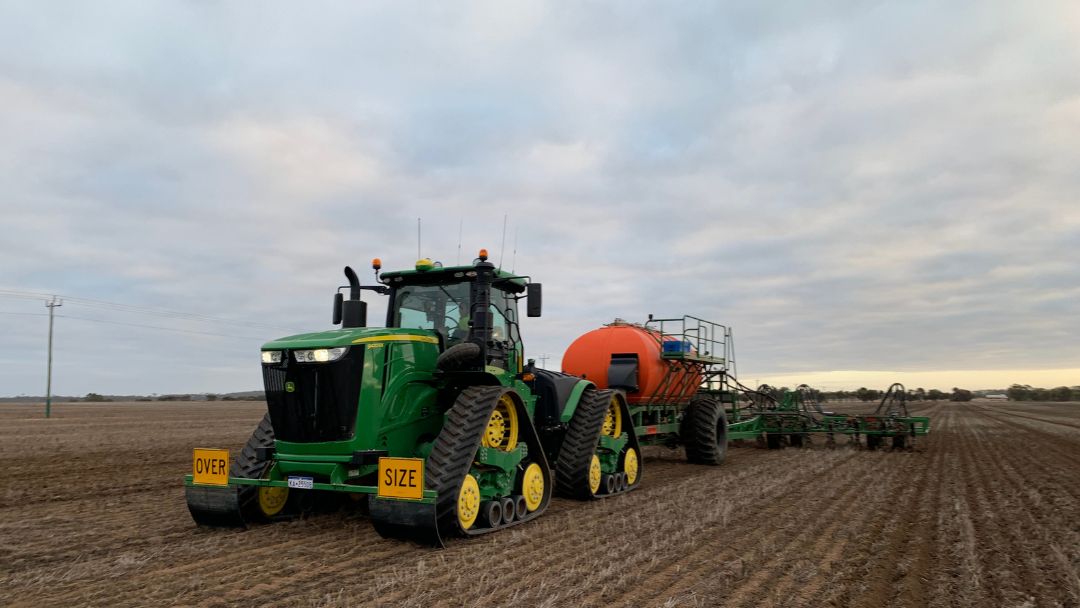
However, it is clear that CTF plays an important foundational role in some farming systems in the West, as shown by these case studies of growers who manage large areas under CTF – Pioneers aim to make every drop count – Grain Automate; Robots, ripping, revised rotations: a reset for the future | GroundCover. Local expert opinion feels that sandy soils have as much, if not more, to gain from CTF. It’s just that compaction needs to be removed mechanically where clay content is lower than 20% as those soils won’t self repair like clay soils in the east. Having removed the compaction with tillage or soil amelioration, CTF is clearly the best option for maintaining the benefits for as long as possible.
Our starting point might be to look at the expected benefits of CTF, all of which have been observed in various environments and industry sectors, although maybe not all in the same place at the same time. Many of these benefits have been demonstrated in the northern grain region, and we should consider to what extent they will also apply in different regions and on different soil types?
The benefits of CTF can be broadly divided into two groups relating to 1) soil, water and crop relationships, and 2) machinery and operations impacts as outlined below.
| Soil, water, crop | Machinery and operations | |
| Improved | · soil structure
· biological activity · infiltration · soil aeration · soil water storage · internal drainage · plant available water · water and fertiliser use efficiency · crop growth · yield |
· trafficability
· timeliness · economics |
| Reduced | · runoff
· erosion · soil borne diseases · waterlogging |
· power requirements
· fuel use · GHG emissions · number of tillage operations · tillage equipment inventory · tractor size · capital and operating costs · operating hours |
There might be many soils or situations where one or more of these is of minor importance, but are there any soil conditions where none of these apply?
Another, less tangible benefit of CTF is the reduction in management‑induced variability across crops and soil. By minimising this variability, it becomes easier to distinguish underlying soil conditions (and/or the effects of intentional management) in satellite imagery—an advantage that is likely to grow in importance for precision agriculture applications.
CTF also enables or enhances the adoption of many other farming system innovations. Its predefined, repeatable traffic lanes create a consistent spatial framework, making it easier to implement activities such as variable‑rate applications, weed mapping and yield mapping.
This is the foundation for route planning as farming systems move towards greater automation. As autonomous technologies become more common, controlled traffic will effectively become the default. The opportunity then is to take the next step—aligning machinery widths and track configurations to minimise the traffic area to fully capitalise on the many benefits CTF offers.
Encouragingly, GRDC has indicated that CTF will be included in a forthcoming Farm Practices Survey. This presents a valuable opportunity to better understand current adoption, track progress over time, and continue supporting informed decision-making around CTF across all regions.