
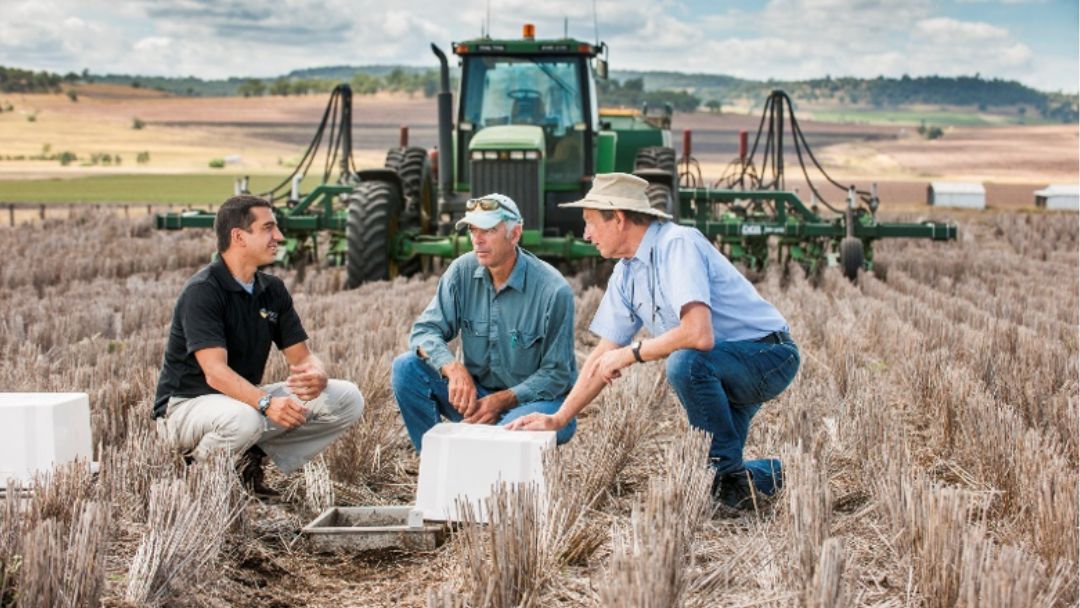
Dio Antille and Jeff Tullberg (ACTFA Board members) and Rob McCreath (CTF grain grower) at one of the GHG project field sites.
ACTFA GHG Emissions Reduction Project Receives Award from UK Institution of Agricultural Engineers
The United Kingdom’s Institution of Agricultural Engineers (IAgrE) has awarded its prestigious Team Environmental Engineer Award to a team led by the Australian Controlled Traffic Farming Assoc. (ACTFA) for its work on greenhouse gas (GHG) emissions from grain cropping. The award highlights the international importance of the Australian project’s findings for broad acre grain cropping.
The project – ‘Nitrous oxide emissions reductions from controlled traffic farming’ – was conducted over four years (2014-2017) at 15 sites in Queensland, Victoria and Western Australia. N2O is an important greenhouse gas (GHG) with about 300 times the global warming potential of carbon dioxide (CO2).
The research team was led by Dr. Jeff Tullberg of ACTFA and included Chris Bluett (ACTFA), Dr. Dio Antille (ACTFA and University of Southern Queensland), Dr. Jochen Eberhard (University of Southern Queensland), and Dr. Clemens Scheer (Queensland University of Technology, now at Karlsruhe Institute of Technology, Germany). Project funding came from the Australian Government’s Department of Agriculture, Fisheries and Forestry Action on the Ground (AOTG) Program.
The project measured GHG emissions from untrafficked crop beds, permanent CTF wheel tracks and single-pass wheel tracks on uncompacted crop beds. By monitoring GHG emissions at various times during the crop growing seasons, the project showed that compacted soil in cropping machinery wheel tracks emitted 2-4 times more N2O than soil that had not been compacted by wheels. This is important because emissions of N2O are the grain industry’s largest contributor to global warming and because nitrogen gas emissions represent the loss of soil nitrogen, an essential and expensive crop nutrient.
The project results, along with several other studies worldwide, show that a high proportion of grain crop GHG emissions and nitrogen losses could be prevented by increasing the adoption of Controlled Traffic Farming (CTF) methods, which confine soil compacting wheels to only 10-15% of the cropped soil area. Although compacted wheel tracks release more N2O than uncompacted soil, on a systems basis, the overall GHG footprint can be reduced by 30-50% under CTF compared to a non-CTF system.
These findings are relevant throughout the grains industry, with greater losses observed in wetter soils and environments. It is likely that similar benefits could be achieved in sugar cane, cotton and horticulture.
It is estimated that less than 40% of the Australian dryland grain crop is grown using full CTF. Converting an additional 50% of the 22 million hectares of dryland crop could reduce annual emissions from grain cropping (estimated in 2015 to be five million tonnes CO2-e) by between 0.6 and 1.7 million tonnes of CO2-e per year.
The award will be presented at the IAgrE Awards Presentation on 29 April at the Royal Agricultural University at Cirencester, UK.
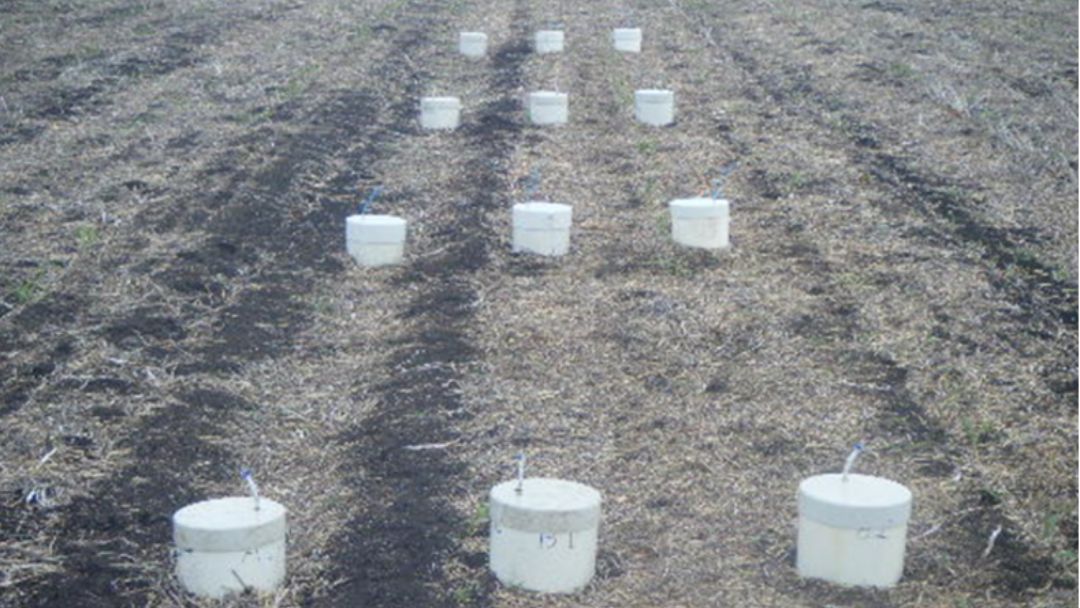
GHG capture chambers in the field.